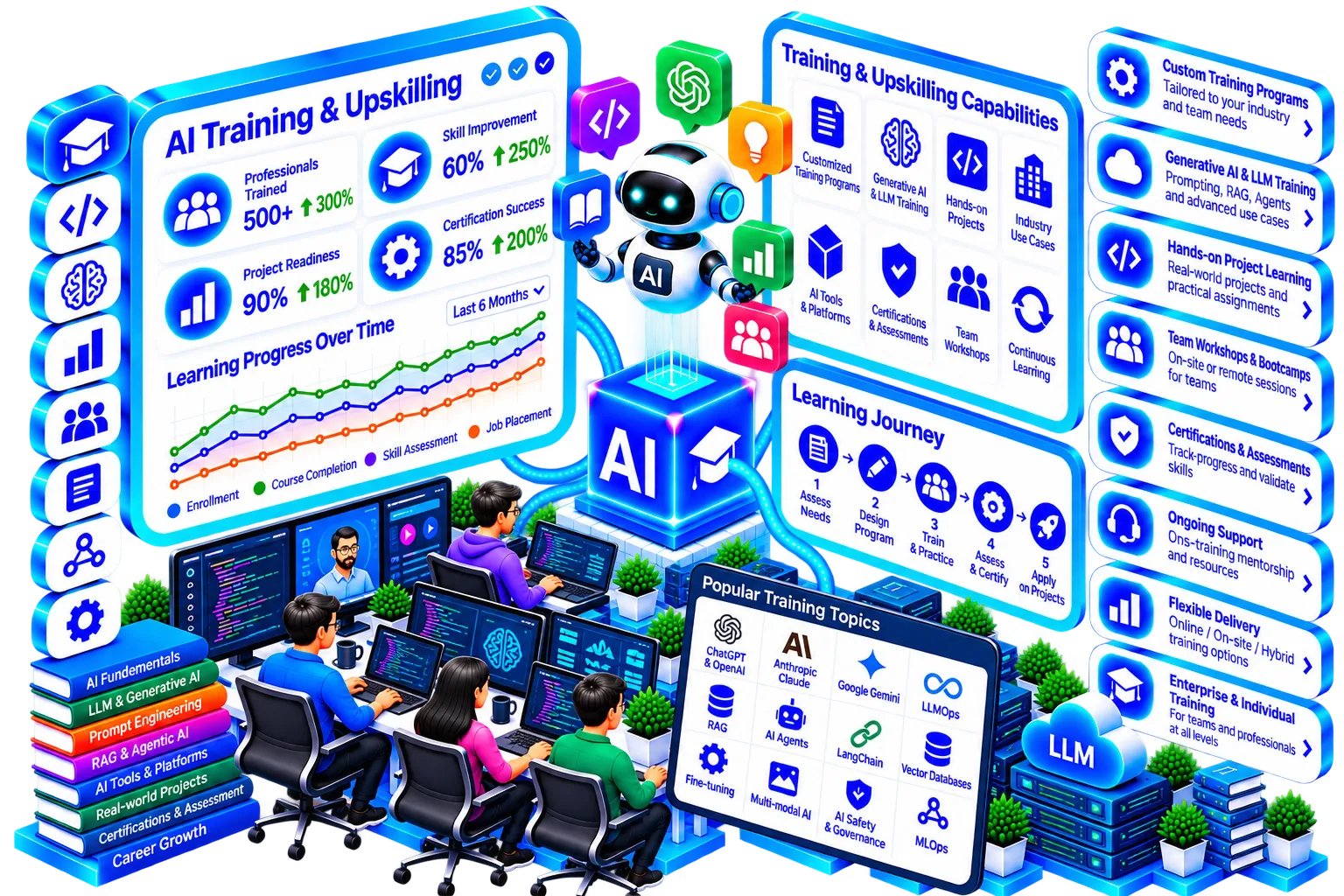
AI Training & Upskilling
Why AI Training & Upskilling
- Training shaped around your actual codebase, stack and AI use cases
- Hands-on exercises that produce working patterns, not just presentation notes
- Shared guidance for building, evaluating and maintaining AI features
- Documentation your team can use after the sessions finish
- A practical hand-off toward in-house ownership and support
Not every organization wants to outsource AI work indefinitely — many want their own team to build the capability to maintain and extend it.
DashCloud's AI training is practical and hands-on, built around your actual codebase and use cases rather than generic slides, so your team leaves able to work independently, not just aware of AI concepts.
Inside AI Training & Upskilling
Hands-on AI development training
Practical sessions working through real examples relevant to your stack and use cases, not generic theory.
- →Real examples from your product or codebase
- →Practical patterns the team can reuse
- →Sessions shaped around the work they actually own
OUTPUT Hands-on AI development training
Team upskilling programs
Structured programs to bring an existing engineering team up to speed on building and maintaining AI features.
- →Structured path for engineering capability
- →Pairing and review on live implementation
- →Support as the team takes ownership
OUTPUT Team upskilling and transition program
Build the capability your team will use
Engineering teams
Build the skills to maintain and extend AI features after an initial build.
Engineering leaders
Upskill the team ahead of a planned AI initiative, rather than learning under deadline pressure.
In-house transition teams
Move from an outsourced AI build to an in-house maintained one with a practical hand-off.
Product teams
Understand how to scope, evaluate and improve AI features with engineering partners.
AI operations owners
Learn the routines needed to monitor, support and improve systems after launch.
Teams starting with AI
Build a shared foundation before the first AI initiative reaches a delivery deadline.
Built around real teams
Engineering teams
Build the skills to maintain and extend AI features after an initial build.
- Which skills do we need for the roadmap?
- What can our team own after training?
- Where should we learn through a real project?
Engineering leaders
Upskill the team ahead of a planned AI initiative, rather than learning under deadline pressure.
- What should we understand before committing to a build?
- How do we evaluate AI output?
- Which patterns fit our existing stack?
Organizations reducing vendor dependence
Transition from an outsourced AI build to an in-house maintained one.
- What needs to be documented for hand-off?
- Who will maintain the system?
- What support is needed after transition?
From learning together to building independently
- 01
Assess
Understand the team’s current skills, codebase, AI goals and the gaps that matter for the work ahead.
Output: Team capability and learning-gap assessment - 02
Plan
Shape a practical learning path around your stack, live use cases and the level of ownership you want in-house.
Output: Practical training path and session plan - 03
Practice
Work through real examples, pair on implementation and apply the lessons directly to your systems.
Output: Working examples applied to your systems - 04
Transition
Leave the team with working patterns, documentation and confidence to maintain and extend the AI system.
Output: Documentation and in-house transition plan
Start with a workshop, or build lasting capability
Focused AI workshop
Give a team practical guidance on one AI capability or workflow.
- ✓Team and use-case preparation
- ✓Focused hands-on session
- ✓Examples for your stack
- ✓Follow-up notes and resources
Team upskilling program
Build the skills your engineering team needs to deliver and maintain AI features.
- ✓Structured learning path
- ✓Hands-on work with your codebase
- ✓Review and pairing on implementation
- ✓Team documentation and patterns
In-house hand-off
Move ongoing ownership from an external team to your own engineers with support.
- ✓System and codebase walkthrough
- ✓Maintenance and evaluation guidance
- ✓Supported transition period
- ✓Clear ownership and next steps
Everything you need to know
Still have questions?
Can't find what you're looking for? Talk to our team and we'll point you in the right direction.
Contact usIt's built around your actual codebase and use cases wherever possible — the goal is a team that can work independently on your systems, not general AI awareness.
Yes — this is a common path after an AI Product Development or Dedicated AI Team engagement, to transition ongoing maintenance in-house.
This is scoped to your team's needs; some engagements are a focused set of workshops, others are ongoing sessions alongside a live project.