
Predictive Analytics
Why Predictive Analytics
- A model trained and validated on your own historical data
- A plain statement of its accuracy and its limits
- Data pipelines that keep the inputs clean and current
- Monitoring for drift as your data changes
- A clear way for people to review what the model flags
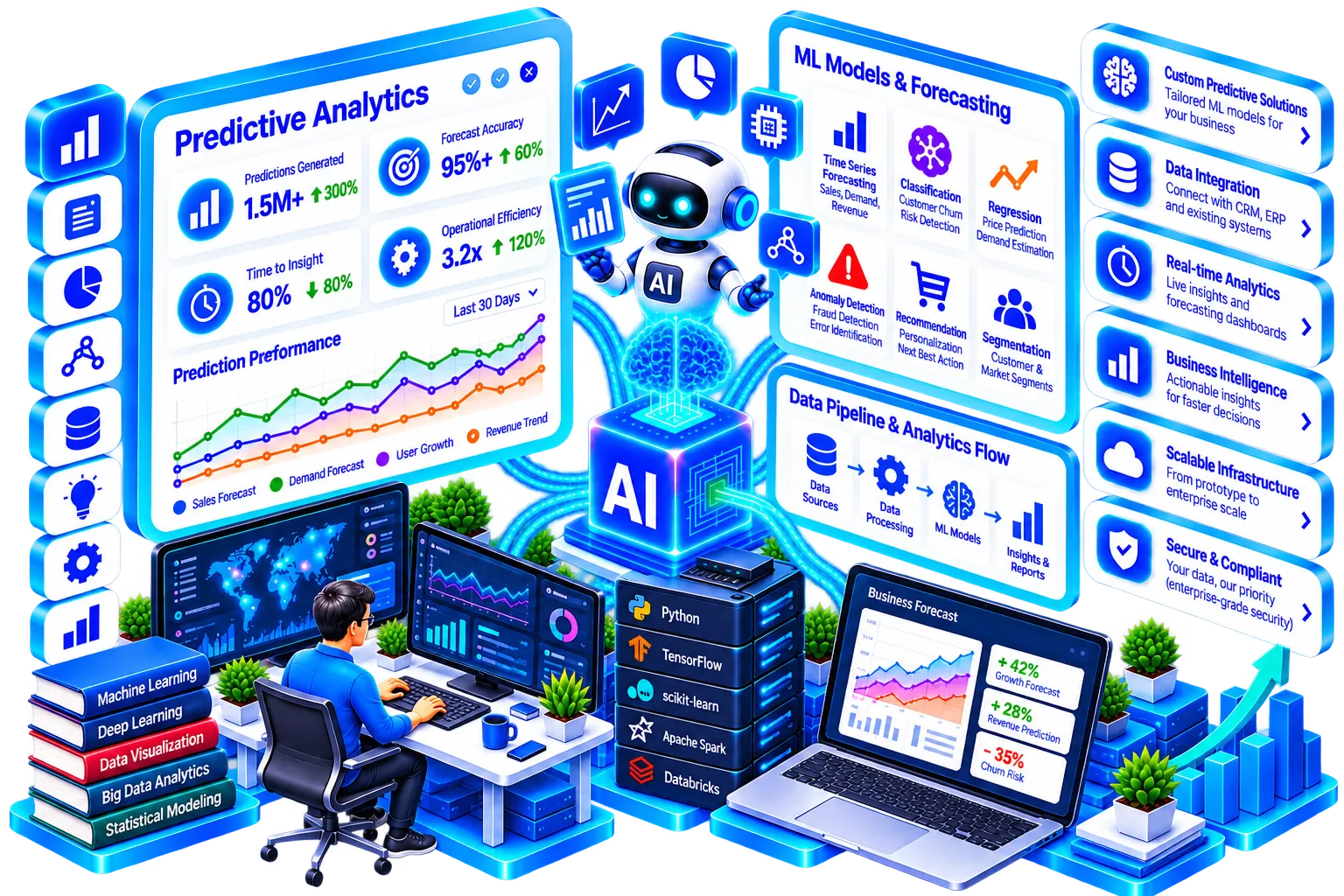
Predictive analytics turns your historical data into a working forecast — what demand looks like next month, which transactions are worth a second look, which customer is about to churn.
DashCloud builds this on top of your existing data warehouse or reporting stack rather than a new isolated system, and we're direct about a model's real accuracy and limits rather than overselling precision. Where the underlying data isn't clean enough yet, that's the first thing we fix, not something we paper over.
Inside Predictive Analytics
Demand and sales forecasting
Forecasting models trained on your historical sales and operational data, tuned to your actual seasonality and patterns.
- →Trained on your sales and operations history
- →Tuned to your real seasonality
- →Forecasts you can plan stock and staff against
OUTPUT Forecast validated on your data
Recommendation and personalization engines
Models that rank products, content or offers per user based on behavior, not static rules.
- →Products, content or offers ranked per user
- →Based on behavior, not static rules
- →Tested against what people actually pick
OUTPUT Ranking model for your catalog
Fraud and anomaly detection
Models that flag transactions or patterns that deviate from the norm, for a person to review rather than an automatic block.
- →Transactions that deviate from the norm
- →Flagged for a person to review
- →No automatic blocking unless you want it
OUTPUT Anomaly flags with a review queue
Data engineering and pipelines
The pipelines that get your data clean, current and structured enough for a model to actually learn from.
- →Sources cleaned, joined and structured
- →Pipelines that keep data current
- →A base a model can actually learn from
OUTPUT Reliable data pipelines
Natural-language BI
Asking questions of your data in plain language and getting a grounded, correct answer back — not a hallucinated number.
- →Questions asked in plain language
- →Answers drawn from your real figures
- →No made-up numbers
OUTPUT Ask-your-data interface
Custom machine learning development
Purpose-built models for problems that don't fit an off-the-shelf tool, scoped and validated against your own data.
- →For problems no off-the-shelf tool fits
- →Scoped around your own data
- →Validated before you commit
OUTPUT Purpose-built model
Where predictions change decisions
Demand planning
Forecast what will sell next month so stock and staffing match demand.
Fraud review
Flag unusual payments early, for a person to check, instead of in a monthly reconciliation.
Churn risk
Spot customers who are drifting away while there is still time to act.
Recommendations
Rank products, content or offers for each user from their behavior.
Cash and revenue outlook
Project revenue and cash from your history to plan with confidence.
Ask your data
Let teams ask questions in plain language and get answers from the real figures.
Built around real teams
Operations teams
Forecast demand accurately enough to plan staffing and inventory with confidence.
- How far ahead can we forecast reliably?
- What does a good forecast change for us?
- How do we plan around the error?
Finance and risk teams
Catch anomalous transactions early instead of finding them in a monthly reconciliation.
- Which transactions need a second look?
- Who reviews what gets flagged?
- How early can we catch it?
Product and growth teams
Personalize recommendations without building a recommendation engine from scratch.
- What should we recommend to whom?
- How do we know it is working?
- How do we test it safely?
From historical data to a working forecast
- 01
Discover
Assess what data exists, how clean it is, and what accuracy would actually be useful.
Output: Data review and accuracy target - 02
Prototype
Train and validate a model against historical data before any production commitment.
Output: Model validated on historical data - 03
Build
Productionize the pipeline and model with monitoring for drift over time.
Output: Production pipeline with monitoring - 04
Deploy & support
Ship with a clear read on accuracy and limitations, and revisit as more data comes in.
Output: Live model with a clear accuracy read
Start with one model, or build the full data foundation
Single prediction model
One model for the question your data can answer best today.
- ✓One focused forecast or detection model
- ✓Validation on your own history
- ✓A plain statement of accuracy
- ✓A review step for what it flags
Data foundation and models
Clean the data first, then build several models on top of it.
- ✓Data engineering and pipelines
- ✓Several models on one foundation
- ✓Natural-language access to your data
- ✓Monitoring for drift over time
Model care
Keep models accurate as your business and data change.
- ✓Regular accuracy reviews
- ✓Retraining as data grows
- ✓New models added over time
- ✓Support when results drift
What we work with
 PythonData warehouses
 dbt


 Cloud AI platforms (AWS / Azure / GCP)PythonData warehousesdbtCloud AI platforms (AWS / Azure / GCP)PythonData warehousesdbtCloud AI platforms (AWS / Azure / GCP)PythonData warehousesdbtCloud AI platforms (AWS / Azure / GCP)PythonData warehousesdbtCloud AI platforms (AWS / Azure / GCP)PythonData warehousesdbtCloud AI platforms (AWS / Azure / GCP)PythonData warehousesdbtCloud AI platforms (AWS / Azure / GCP)PythonData warehousesdbtCloud AI platforms (AWS / Azure / GCP)PythonData warehousesdbtCloud AI platforms (AWS / Azure / GCP)PythonData warehousesdbtCloud AI platforms (AWS / Azure / GCP)PythonData warehousesdbtCloud AI platforms (AWS / Azure / GCP)PythonData warehousesdbtCloud AI platforms (AWS / Azure / GCP)
Everything you need to know
Still have questions?
Can't find what you're looking for? Talk to our team and we'll point you in the right direction.
Contact usIt depends entirely on your data's history and quality — we validate against your real data before committing to a production rollout, and we'll tell you plainly if accuracy isn't there yet.
It helps, but isn't required — data engineering to get you there is often the first phase of the engagement.
Typically it flags for review rather than blocking automatically, unless you specifically want an automated action and accept that tradeoff.
Yes — natural-language BI lets you query your data conversationally, grounded in your actual figures rather than a generated guess.