RAG & Enterprise Knowledge
Why RAG & Enterprise Knowledge
- A working question-and-answer system over your own documents
- Connections to where your content already lives
- Source citations attached to every answer
- Defined behavior for when the system is not confident
- A way to keep the index fresh as your content changes
A general-purpose model doesn't know your contracts, your product catalog or last quarter's reports — and left ungrounded, it will guess.
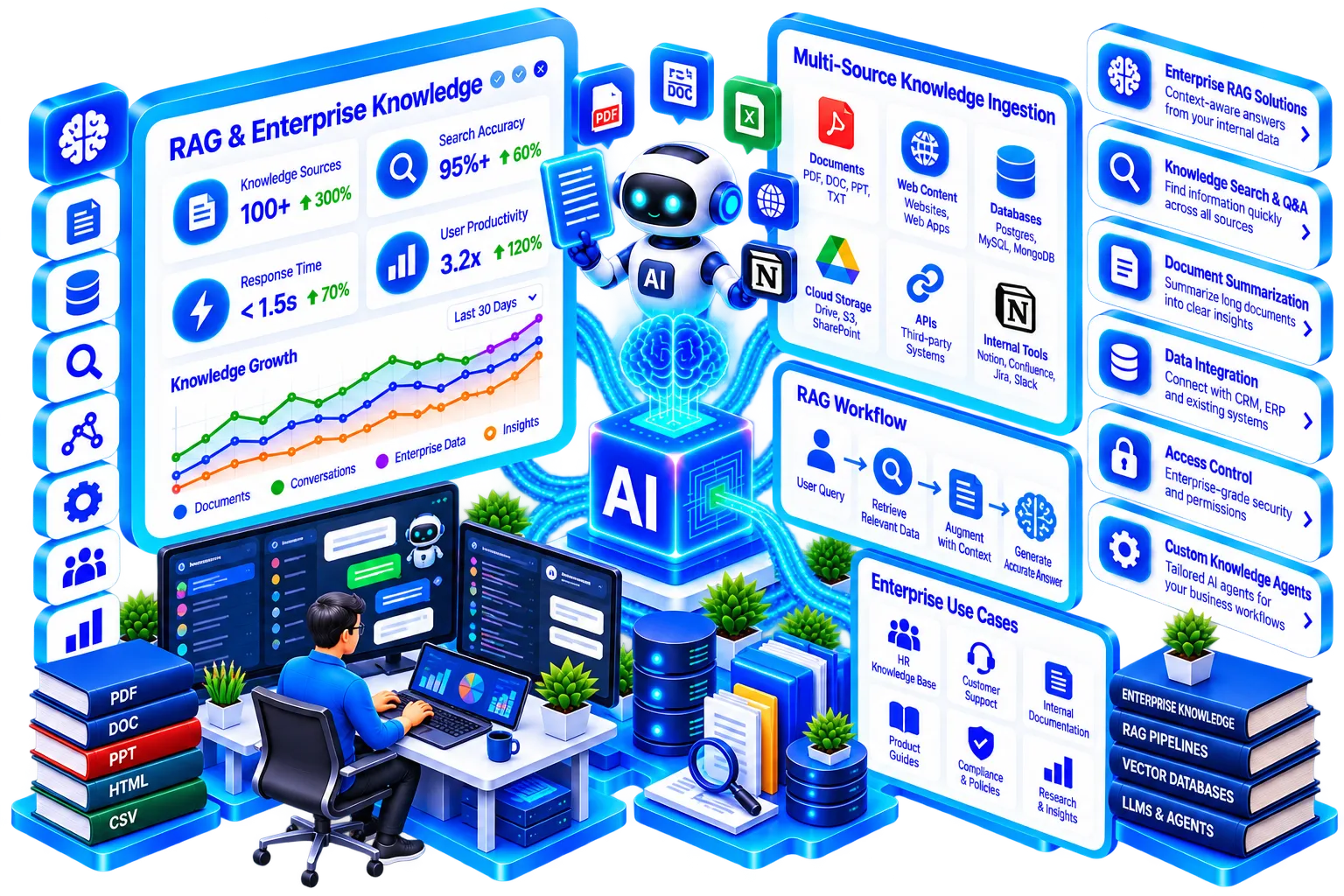
Retrieval-augmented generation (RAG) fixes this by connecting the model to your actual documents and databases at query time, so answers are grounded in real, current information and can cite where they came from. DashCloud builds RAG systems on top of your existing document stores, wikis and databases, rather than asking you to migrate content anywhere new.
Inside RAG & Enterprise Knowledge
Document and knowledge-base retrieval
Search and retrieval over your PDFs, wikis, tickets and internal docs, so the model answers from what's actually there.
- →PDFs, wikis, tickets and internal docs
- →Search that finds the right passage
- →Answers drawn from what is actually there
OUTPUT Q&A over your documents
Database-grounded Q&A
Connecting structured data — orders, records, reports — so questions get answered from live figures, not stale training data.
- →Orders, records and reports connected
- →Questions answered from live figures
- →No stale training data
OUTPUT Q&A over your live data
Source citation and confidence
Answers that reference where they came from, and a defined behavior for when the system isn't confident enough to answer.
- →Each answer points to its source
- →A defined response when confidence is low
- →Escalation instead of a guess
OUTPUT Cited answers with confidence rules
Where grounded answers make the difference
Employee help desk
Let people ask HR, IT and policy questions and get answers from the current documents.
Support assistant
Ground replies in your help center and past resolutions, not general knowledge.
Compliance lookup
Find the clause or rule behind an answer, with the source attached.
Sales enablement
Answer product and pricing questions from your catalog and latest materials.
Onboarding
Help new joiners find what they need across wikis and shared drives.
Reports and records
Ask questions of orders, records and reports and get the current numbers.
Built around real teams
Internal knowledge teams
Let employees ask questions in plain language and get answers grounded in internal documentation.
- Where does our knowledge actually live?
- Which questions come up again and again?
- How current do the answers need to be?
Customer support teams
Ground a support assistant in the actual help center and past resolutions, not general knowledge.
- Which past resolutions should it learn from?
- When should it hand over to an agent?
- How do we keep the help center in sync?
Compliance and legal teams
Get answers with a traceable source, not an unverifiable generated summary.
- How do we trace an answer to its source?
- What if the answer is not in the documents?
- Who can see which documents?
From scattered documents to trusted answers
- 01
Discover
Map where your knowledge lives, who asks questions of it and what a good answer looks like.
Output: Source map and question list - 02
Prototype
Build retrieval over a real slice of your documents and test it against questions your team actually asks.
Output: Working retrieval on real documents - 03
Build
Connect all your sources, add source citations and set how the system behaves when it is not confident.
Output: Connected sources with cited answers - 04
Deploy & support
Launch to your team, then keep the index fresh and improve answers from real questions.
Output: Live system with a fresh index
Start with one source, or connect everything
Single-source assistant
One assistant grounded in the source your team searches the most.
- ✓One document source or database
- ✓Cited answers
- ✓A clear fallback when unsure
- ✓Testing on real questions
Enterprise knowledge system
One question box across your documents, wikis and databases.
- ✓Several sources connected in place
- ✓Access rules that follow your documents
- ✓Source citations on every answer
- ✓Monitoring of questions and gaps
Keep it current
Keep answers accurate as your content grows and changes.
- ✓Regular index refreshes
- ✓Review of unanswered questions
- ✓New sources added over time
- ✓Support when something needs fixing
What we work with


 Vector databases
 OpenAI
 Anthropic
 PythonCloud AI platformsVector databasesOpenAIAnthropicPythonCloud AI platformsVector databasesOpenAIAnthropicPythonCloud AI platformsVector databasesOpenAIAnthropicPythonCloud AI platformsVector databasesOpenAIAnthropicPythonCloud AI platformsVector databasesOpenAIAnthropicPythonCloud AI platformsVector databasesOpenAIAnthropicPythonCloud AI platformsVector databasesOpenAIAnthropicPythonCloud AI platformsVector databasesOpenAIAnthropicPythonCloud AI platformsVector databasesOpenAIAnthropicPythonCloud AI platforms
Everything you need to know
Still have questions?
Can't find what you're looking for? Talk to our team and we'll point you in the right direction.
Contact usRAG retrieves the relevant passages from your actual, current documents at query time and grounds the answer in them — rather than relying on a general model's training data, which doesn't know your content and can be wrong or outdated.
No — we build retrieval on top of where your documents already live (file storage, wikis, databases) rather than requiring a migration.
We design it to say so and escalate, rather than generate a plausible-sounding but wrong answer.
No — retrieval keeps your data in your own systems at query time; it isn't used to train third-party models.