AIoT & Edge AI
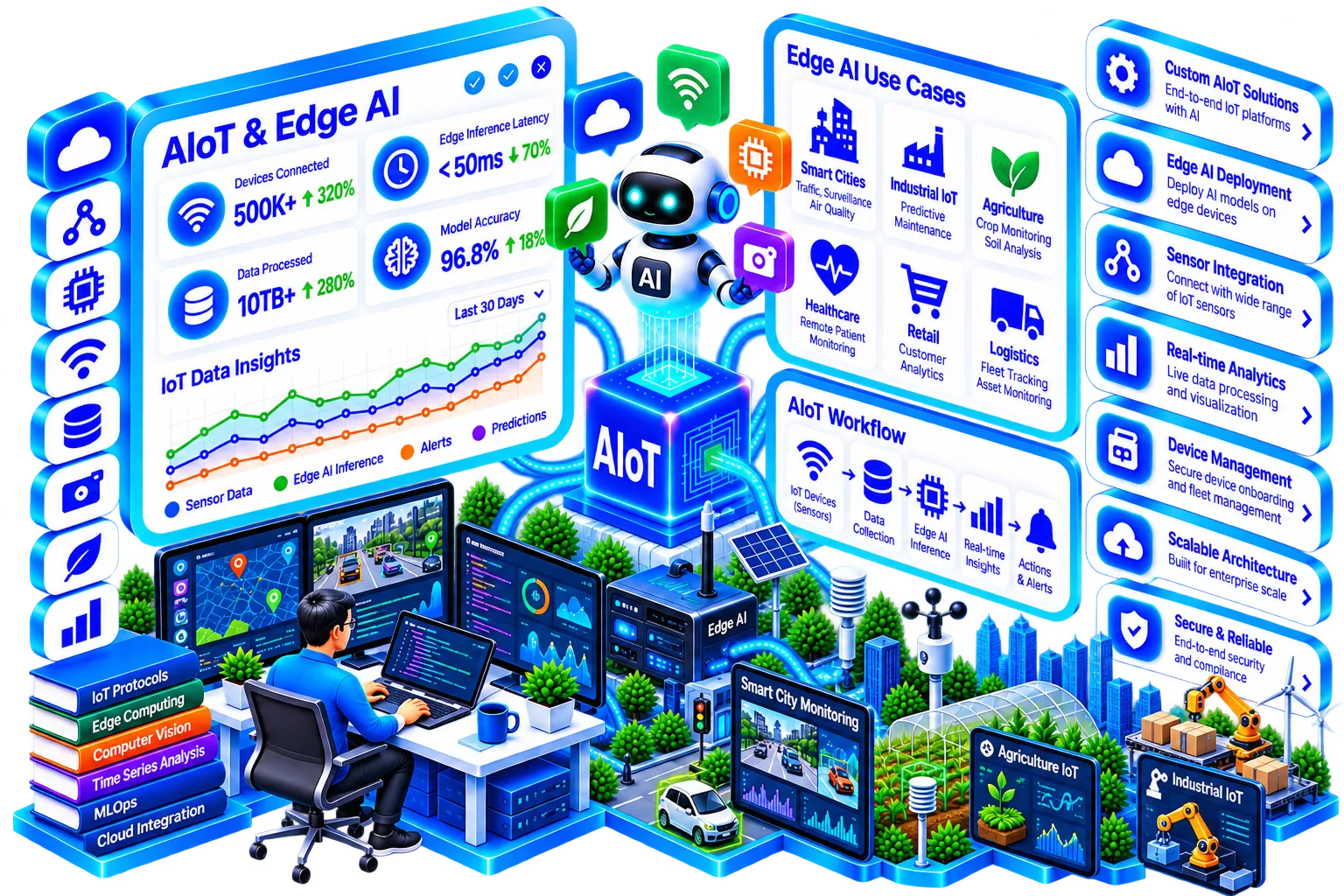
Why AIoT & Edge AI
- A model that runs directly on your local hardware
- Connections to the sensors and equipment you already have
- Behavior that keeps working when the connection drops
- Data that syncs back to the cloud when it can
- A plain read on accuracy, validated on your own machines
Not every AI use case can wait for a round trip to the cloud, or should — a machine on a factory floor may need to react in milliseconds, or run somewhere with unreliable connectivity.
DashCloud builds AIoT and edge AI systems that run models directly on-device, connected to your existing sensors and equipment, syncing back to the cloud when a connection is available rather than depending on it.
Inside AIoT & Edge AI
Predictive maintenance
Models running on or near equipment that flag likely failures before they happen, based on sensor data your machines already produce.
- →Likely failures flagged before they happen
- →Built on sensor data your machines already produce
- →Warnings sent to the people who can act
OUTPUT Failure warnings for your equipment
On-device inference
Running a trained model directly on local hardware, for use cases that need low latency or need to work without a constant connection.
- →A trained model running on local hardware
- →Low latency, with no cloud round trip
- →Keeps working without a connection
OUTPUT On-device model running locally
Where intelligence belongs next to the machine
Predictive maintenance
Warn about a likely failure from vibration, heat or current data before the machine stops.
Real-time alerts
React in milliseconds to a reading that a cloud round trip would be too slow for.
Remote sites
Run monitoring where the internet is weak or missing, and sync later.
Line monitoring
Watch a production line locally and flag drift in a process as it happens.
Field equipment
Give crews insight from equipment in the field without waiting on the cloud.
Energy and utilities
Spot unusual consumption or equipment behavior at the source.
Built around real teams
Manufacturing teams
Catch equipment failures before they cause downtime, using data the machines already generate.
- Which failures cost us the most?
- What sensor data do we already collect?
- How early do we need the warning?
Facilities teams
Run monitoring at sites with unreliable or no internet connectivity.
- Which sites have weak connectivity?
- What must keep running offline?
- How does data get back when we are online?
Field operations teams
Get real-time insight from equipment without waiting on a cloud round trip.
- Which readings need an instant reaction?
- Where should the model run?
- How do alerts reach the crew?
From sensor data to intelligence on the device
- 01
Discover
Review the equipment, the sensors you already have and what a useful warning would look like.
Output: Equipment and sensor review - 02
Prototype
Train and test a model on real data from your own machines before any hardware decision.
Output: Model tested on your machine data - 03
Build
Run the model on local hardware and connect it to your sensors, equipment and existing dashboards.
Output: Model running on local hardware - 04
Deploy & support
Roll out to the site, sync back when a connection is available, and tune as conditions change.
Output: Live on site with sync
Prove it on one machine, or roll it out across sites
Single-machine pilot
Prove a warning or on-device model on one machine or one site.
- ✓One machine or one site
- ✓Use of the sensors you already have
- ✓Testing on your own equipment data
- ✓A plain read on accuracy
Multi-site rollout
Take a proven model across your machines and locations.
- ✓Models on local hardware at each site
- ✓Offline operation with sync back
- ✓Feeds into your existing dashboards
- ✓Monitoring across sites
Model care
Keep models accurate as equipment and conditions change.
- ✓Regular accuracy checks
- ✓Retraining on new machine data
- ✓New machines or sites added
- ✓Support when results drift
What we work with
 Python

 Cloud AI platforms (AWS / Azure / GCP)IoT sensor platformsEdge devicesPythonCloud AI platforms (AWS / Azure / GCP)IoT sensor platformsEdge devicesPythonCloud AI platforms (AWS / Azure / GCP)IoT sensor platformsEdge devicesPythonCloud AI platforms (AWS / Azure / GCP)IoT sensor platformsEdge devicesPythonCloud AI platforms (AWS / Azure / GCP)IoT sensor platformsEdge devicesPythonCloud AI platforms (AWS / Azure / GCP)IoT sensor platformsEdge devicesPythonCloud AI platforms (AWS / Azure / GCP)IoT sensor platformsEdge devicesPythonCloud AI platforms (AWS / Azure / GCP)IoT sensor platformsEdge devicesPythonCloud AI platforms (AWS / Azure / GCP)IoT sensor platformsEdge devicesPythonCloud AI platforms (AWS / Azure / GCP)IoT sensor platformsEdge devicesPythonCloud AI platforms (AWS / Azure / GCP)IoT sensor platformsEdge devicesPythonCloud AI platforms (AWS / Azure / GCP)IoT sensor platforms
Everything you need to know
Still have questions?
Can't find what you're looking for? Talk to our team and we'll point you in the right direction.
Contact usOften existing sensors and equipment can be used; we assess what you already have before recommending new hardware.
Edge models are designed to keep running locally and sync data back once a connection is available, rather than depending on constant connectivity.
It depends on the quality and history of your sensor data — we validate against your real equipment data before a production rollout.
Yes — edge AI typically feeds back into your existing systems rather than requiring a new dashboard.